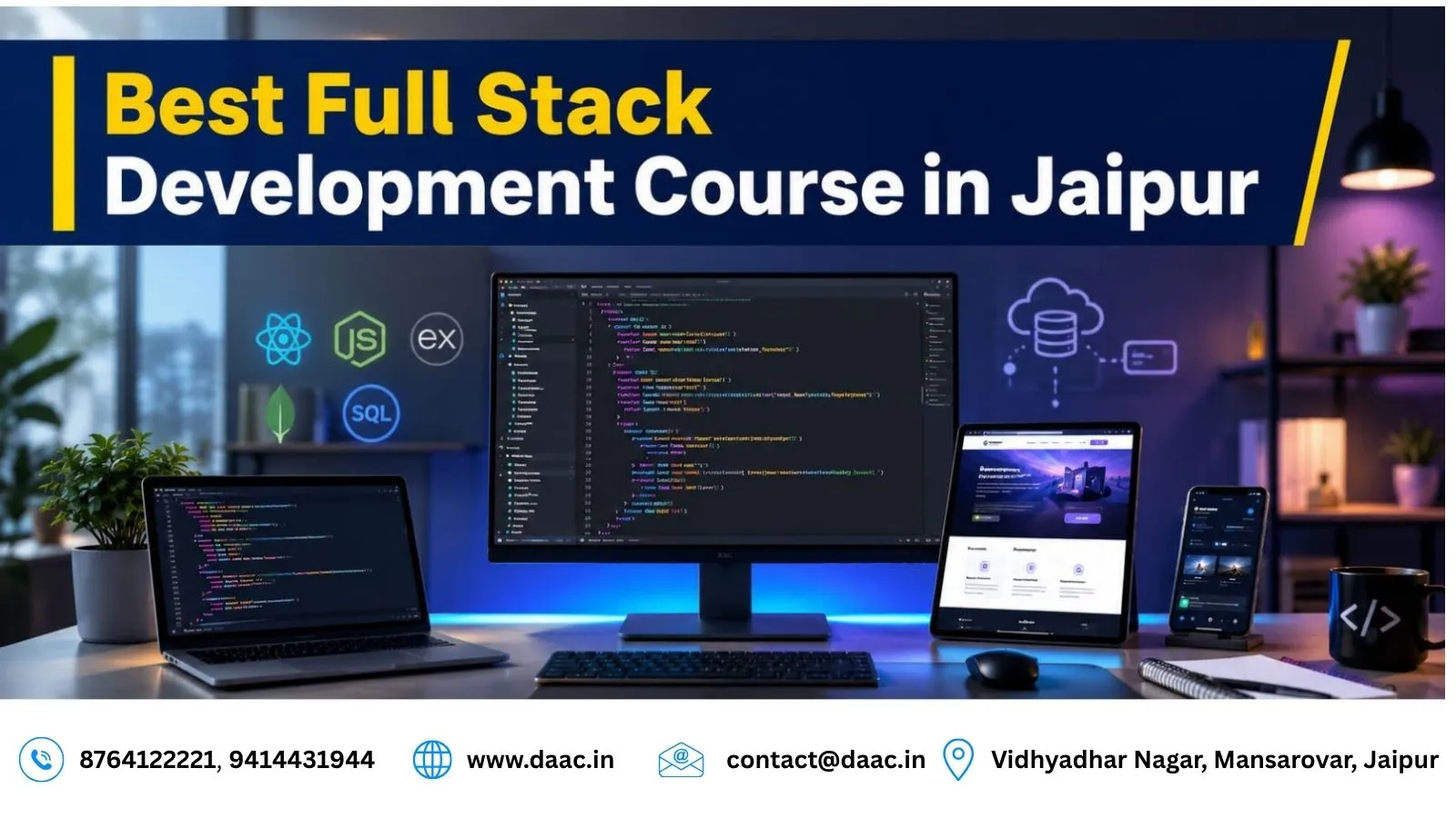
Full stack development is a valuable technical skill for people who want to build a career in web development and software engineering. Businesses need websites and web applications that offer smooth user experiences, reliable functionality, and secure data management. This has increased interest in a Full Stack Development Course in Jaipur among students, graduates, and aspiring developers.
A full stack developer works with both the front end and back end of a web application. This includes creating user interfaces, writing application logic, connecting databases, integrating APIs, and preparing applications for deployment. Learning these skills can help beginners understand the complete web development process and prepare for a range of technical roles.
1. What Is a Full Stack Development Course in Jaipur?
A Full Stack Development Course in Jaipur is a structured learning program that teaches students how to develop complete web applications. It covers front-end development, back-end programming, database management, version control, and deployment fundamentals.
Front-end development
Front-end development focuses on the parts of a website that users see and interact with. Students typically learn:
-
HTML to structure web pages
-
CSS to style layouts and improve visual presentation
-
JavaScript to add interactive features
-
Responsive design for mobile, tablet, and desktop screens
-
React or another suitable front-end framework
These skills help learners create accessible, responsive, and user-friendly interfaces.
Back-end development and databases
Back-end development manages application logic, server communication, authentication, and data processing. Depending on the syllabus, students may learn technologies such as Node.js, PHP, Python, or Java.
Database training may include MySQL or MongoDB. Students also learn how front-end interfaces communicate with back-end services through APIs.
A complete training program connects these areas through practical exercises so learners understand how the different components work together.
2. Why Choose Full Stack Development as a Career?
Full stack development can be a suitable career path for people who enjoy programming, logical thinking, and solving technical problems. Developers with knowledge of both front-end and back-end technologies can contribute to multiple stages of application development.
Diverse career opportunities
Full stack skills can be useful in IT companies, startups, software development agencies, e-commerce businesses, and organizations that maintain their own digital products. Depending on their abilities, learners may pursue developer roles or specialize in a particular technology.
Opportunities for freelance and independent projects
Experienced developers may work on websites, business applications, dashboards, and other web-based projects for clients. Freelancing requires more than coding skills: communication, project planning, time management, and client coordination are also important.
Continuous learning and specialization
Web development technologies continue to evolve. Developers can expand their knowledge in cloud services, application security, automated testing, performance optimization, or modern JavaScript frameworks.
A professional Full Stack Developer Training program can provide the foundation, but career growth depends on consistent practice, project experience, and ongoing learning.
3. What You Learn in Full Stack Development Training in Jaipur
A well-structured Full Stack Development Training in Jaipur program should move from programming fundamentals to complete application development.
Core programming and front-end technologies
The syllabus may cover:
-
HTML, CSS, and JavaScript
-
Responsive web design
-
JavaScript functions, objects, and asynchronous programming
-
Front-end frameworks such as React
-
Form handling and user interaction
-
Reusable components and application structure
Learners should practise by building web pages and gradually progressing to interactive interfaces.
Back-end programming and database management
Back-end modules may include server-side programming, routing, authentication concepts, API development, and database operations.
Students should understand how to create, retrieve, update, and delete data, validate user input, and handle common application errors. Security fundamentals should also be introduced when working with user accounts and sensitive information.
Git, APIs, testing, and deployment
Version control with Git and GitHub helps developers track code changes and collaborate with others. API integration allows different software components to exchange information.
Students should also learn basic debugging, application testing, environment configuration, and deployment. These skills help turn a local practice project into an application that can be accessed online.
4. How to Choose the Best Full Stack Development Course in Jaipur
Choosing the right institute involves evaluating the quality of teaching, syllabus, practical exposure, and learner support rather than relying only on promotional claims.
Check the curriculum
Confirm that the course includes both front-end and back-end development, databases, APIs, version control, and deployment. Ask which programming languages and frameworks are taught and whether the syllabus is appropriate for beginners.
Evaluate practical training
Look for a program that includes regular coding exercises and complete projects. Useful examples include a portfolio website, a task management application, an e-commerce demonstration, or an admin dashboard.
Ask whether trainers review assignments and help students understand errors instead of simply providing finished code.
Review trainer support and placement assistance
Find out how trainers explain difficult concepts, answer questions, and assess student progress. If placement assistance is advertised, ask what it includes, such as resume preparation, mock interviews, project guidance, and job application support.
Placement assistance should not be treated as a guarantee of employment.
Compare learning formats and fees
Classroom learning may offer direct interaction, while online courses can provide greater flexibility. Compare the total fees, duration, class schedule, project requirements, and any additional costs before making a decision.
5. Best Institutes and Learning Options for Full Stack Development
Students in Jaipur can compare local training institutes with online learning platforms. Each option has different advantages, and the best fit depends on learning preferences and career objectives.
Classroom-based training
A local institute may provide scheduled classes, trainer interaction, peer learning, and guided practical sessions. Before enrolling, review the actual curriculum, visit the institute if possible, and ask about project work and student support.
DAAC is one option to investigate when comparing local technical training programs. Prospective students should confirm the current syllabus, course structure, fees, and available support directly with the institute.
Online learning platforms
Online platforms offer video lessons, coding exercises, and self-paced learning. They can be useful for learners who prefer flexible schedules or want to supplement classroom training.
However, students who choose self-paced courses need to maintain a regular practice routine and seek feedback when they encounter difficult programming problems.
How to make the right decision
Compare options based on teaching quality, curriculum depth, practical projects, mentor availability, and affordability. Choose the learning environment that helps you practise consistently and build a portfolio.
6. Career Opportunities After a Full Stack Development Course in Jaipur
After gaining the required technical skills and project experience, learners can explore several entry-level and specialist roles.
Common job roles
-
Full Stack Developer: Works on front-end and back-end components of applications.
-
Front-End Developer: Builds user interfaces and interactive website features.
-
Back-End Developer: Develops server-side logic, APIs, and data processing.
-
Web Developer: Creates and maintains websites and web applications.
-
Software Developer: Helps design, build, test, and maintain software.
-
Junior Application Developer: Supports the development and maintenance of business applications.
The responsibilities of these roles vary between organizations, so applicants should review job descriptions and develop the specific skills employers require.
Building a strong project portfolio
A portfolio helps demonstrate practical ability. Students can include a responsive website, an application connected to a database, an API-based project, and a project hosted online.
For every project, explain its purpose, technologies, key features, and challenges solved. Make sure the code is organized and that projects can be demonstrated reliably during interviews.
7. Importance of Practical Projects and Future Scope
Practical learning helps students understand how individual programming concepts fit into a complete application. It also develops debugging, planning, testing, and problem-solving skills.
Projects to practise during training
Beginners can start with a personal portfolio or a simple task tracker. As their skills improve, they can build a database-driven blog, an inventory management application, or an e-commerce demonstration with appropriate security and validation.
Emerging areas to explore
Developers may later expand into cloud deployment, progressive web applications, automated testing, application security, or AI-powered features. These areas build on core programming knowledge and may require additional specialized learning.
The future opportunities available to an individual depend on technical proficiency, project quality, communication, and the ability to adapt to new technologies.
Conclusion
Choosing the right Full Stack Development Course in Jaipur can help you build a foundation in front-end development, back-end programming, databases, APIs, and deployment. Before enrolling, compare the curriculum, practical projects, trainer guidance, fees, duration, and career support.
DAAC is an option to consider when exploring local technical training. Review the current course details and select a program that matches your goals. With regular coding practice, real projects, and continuous learning, you can work toward a career in full-stack and web development.